> For the complete documentation index, see [llms.txt](https://docs.petoi.com/llms.txt). Markdown versions of documentation pages are available by appending `.md` to page URLs; this page is available as [Markdown](https://docs.petoi.com/apis/serial-protocol.md).
# Serial Protocol
We have defined a set of serial communication protocols for robots:
All the tokens start with a single ASCII-encoded character to specify their parsing format. They are case-sensitive and usually in lowercase.
{% hint style="info" %}
Some commands, like the **c** and **m** commands, can be combined.
For example:
Successive "m8 40", "m8 -35", "m 0 50" can be written as "m8 40 8 -35 0 50".
You can change the limit in the code, but there might be a systematic constraint for the serial buffer.
{% endhint %}
Try the following serial commands in [the serial monitor](https://docs.petoi.com/arduino-ide/serial-monitor):
* “**k**sit”
* “**m**0 30”
* “**m**0 -30”
* “**k**balance”
* “**k**wkF”
* “**k**trL”
* “**d**”
{% hint style="warning" %}
The quotation mark indicates that they are character strings. Don’t type quotation marks in the serial monitor.
{% endhint %}
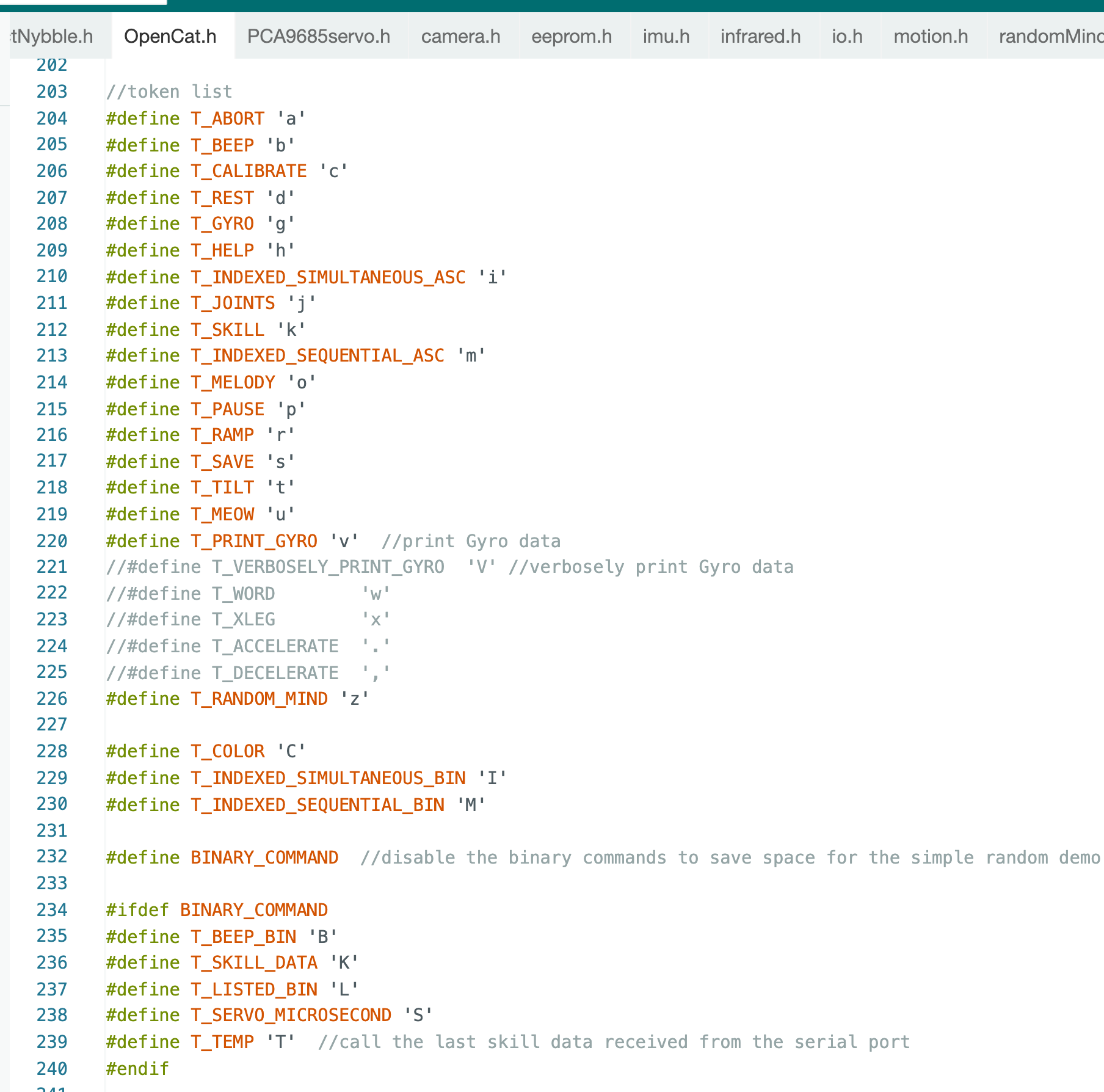
You can refer to the macro definitions in OpenCat.h to utilize the most updated sets of tokens.
{% @github-files/github-code-block url="" %}
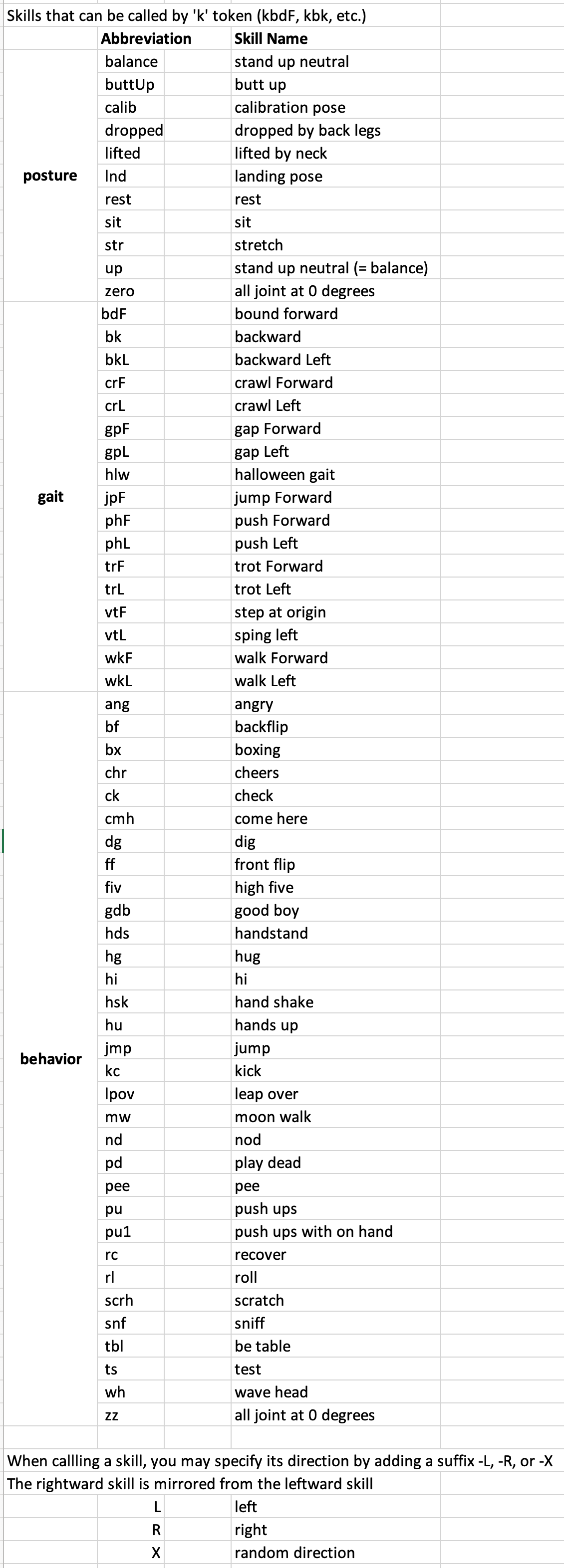
Some more available commands for skills:
The complete set of skills in effect is defined in [InstinctBittle.h](https://github.com/PetoiCamp/OpenCat/blob/main/src/InstinctBittle.h) or [InstinctNybble.h](https://github.com/PetoiCamp/OpenCat/blob/main/src/InstinctNybble.h):\
For example:
{% code overflow="wrap" %}
```cpp
const char* skillNameWithType[]={"bdFI","bkI","bkLI","crFI","crLI","hlwI","mhFI","mhLI","pcFI","phFI","phLI","trFI","trLI","vtFI","vtLI","wkFI","wkLI","balanceI","buttUpI","calibI","droppedI","liftedI","restI","sitI","strI","zeroN","bfI","ckI","climbCeilI","fdI","ffI","hiI","jyI","pdI","peeI","puI","pu1I","rcI","rlLI","rtI","stpI","tsI",};
```
{% endcode %}
All the skill names in the list can be called by adding a 'k' to the front and deleting the suffix. For example, there's "sitI" in the list. You can send "ksit" to call the sitting posture. If a skill has "F" or "L" as the second last character, it's a gait. It means walking forward or left. Walking right is a mirror of walking left. So you can send "kwkF", "kwkL", "kwkR" to make the robot walk. Similarly, there are other gaits like trot ("tr"), crawl ("cr"), and stepping ("vt").
---
# Agent Instructions
This documentation is published with GitBook. GitBook is the documentation platform designed so that both humans and AI agents can read, navigate, and reason over technical content effectively. Learn more at gitbook.com.
## Querying This Documentation
If you need additional information that is not directly available in this page, you can query the documentation by asking a question.
Perform an HTTP GET request on the following URL with the `ask` and `goal` query parameters:
```
GET https://docs.petoi.com/apis/serial-protocol.md?ask=&goal=
```
`ask` is the immediate question: it should be specific, self-contained, and written in natural language.
`goal` is what the user is ultimately trying to achieve, the reason they need the answer. Sharing it helps GitBook give you a better, more relevant answer. A goal is most helpful when it describes the outcome the user wants rather than restating the question. For example, with `ask=how do I create an API token`, a goal like `automate deployments from our CI pipeline` lets GitBook tailor the answer to that use case.
The response will contain a direct answer to the question and relevant excerpts and sources from the documentation.
Use this mechanism when the answer is not explicitly present in the current page, you need clarification or additional context, or you want to retrieve related documentation sections.